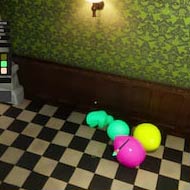
The preparation timer hits zero and you are still standing in the wrong corner — white as a piece of printer paper, completely undisguised, with Seekers about to flood through the door. You open Meccha Paint in a panic, drag the Spoid across the nearest wall, slap the color across your body in six strokes, and drop into a crouch. A Seeker walks in. Scans the room. Turns and leaves. You just survived your first real disguise in Meccha Chameleon, and it took you about fifteen seconds of chaos to understand what this hide-and-seek game actually demands.
Meccha Chameleon is a multiplayer hide-and-seek game built around one idea that changes everything: Hiders do not find objects to hide behind — they become the objects. Every match splits players into two sides. Hiders enter the stage as plain white figures and spend the preparation window painting their bodies to match the environment around them. Seekers are released once that window closes and must find everyone before the timer runs out. The game ends when all Hiders are tagged or at least one survives the full round.
What makes Meccha Chameleon distinct from similar party titles is that no disguise is preset. There is no menu offering “become a chair,” no random prop assignment. You open the Meccha Paint interface, study the wall behind you, and reproduce its colors and surface texture on your own body — under time pressure, while choosing a position and pose that makes the result believable. Players who master Meccha Paint survive. Players who do not are white blobs in corners, tagged inside the first thirty seconds of the hunt phase.
The shot system gives Meccha Chameleon a strategic layer that pure hide-and-seek titles lack. Seekers cannot fire at every suspicious object because shots are limited — burning them on furniture wastes the resource needed for actual Hiders. Experienced Meccha Chameleon Hiders track Seeker shot economy as the round develops and use it to decide when to stay still versus when to shift position.
Genre
Multiplayer party / hide-and-seek
Platform
PC (Steam)
Core mechanic
Paint your white character body to blend into the stage; Seekers identify disguised players by shape and anomaly
The Preparation Phase: Where Meccha Chameleon Is Won
New players treat preparation as downtime before the game actually starts. Experienced Meccha Chameleon players treat it as the only phase that matters. The hunt reveals whether your preparation was good enough — it does not give you a chance to fix it. By the time Seekers enter the stage, everything that will determine whether you survive or get tagged in the first sweep has already been decided.
The ordering of decisions inside preparation matters more than most players realize. The instinct is to find a spot first and paint second, which produces a rushed paint job on whatever time is left. The better approach is to scout candidate positions, use the Spoid to sample nearby surfaces before committing, and settle into a final position already knowing what the paint will look like. Players who prepare Meccha Chameleon hides in this order — area first, paint knowledge second, final spot last — survive longer even with a middling disguise.
Pose is what separates intermediate from advanced Meccha Chameleon players. The Pose Wheel locks your body into a shape that matches the geometry nearby — arms to sides against a flat wall, a crouch matching furniture height, a lean following an adjacent slope. Seekers recognize human shapes before they notice color mismatches in this game, and a slightly off color in a convincingly inhuman pose fools them longer than a perfect paint job on someone standing upright. The first time a Seeker stops right next to you and keeps walking is when Meccha Chameleon preparation finally makes sense.
The Meccha Paint System
The Meccha Paint interface is the game’s most complex system and the one with the steepest skill gap between new and experienced players. Pressing F opens a panel with a color wheel, RGB and HSV sliders, a stored palette bank, metallic and roughness controls, and the Spoid eyedropper that samples color from any surface in the game world. These tools give Hiders in Meccha Chameleon the ability to reproduce not just a surface’s color but its material behavior — the difference between a glossy tile floor and a matte plaster wall is captured in the roughness and metallic sliders, not in the color wheel alone.
The Spoid is the single tool that most dramatically improves a beginner’s disguise quality in Meccha Chameleon. Human color memory degrades fast under time pressure, especially for the muted tones that make up most game environments. Walls that look “light grey” from across a room turn out to be warm beige with a subtle blue cast when sampled directly. The color sync timing guide covers how to handle lighting variance when preparation time is almost gone.
The Too-Buried warning fires when your character’s body geometry clips into map surfaces — pressing too hard into a corner triggers it most often. Back off slightly until the alert clears, then re-lock your pose. Ignoring it risks a forced reposition mid-hunt, which means visible movement at exactly the wrong moment in the game.
Playing Seeker
Players who switch to Seeker after a few rounds as Hider usually hunt the same way they hid — scanning for color mismatches, moving fast, covering ground. Against beginners this works. Against anyone who used the Spoid correctly in this game, it does not. The paint will be accurate enough that a quick visual scan registers nothing wrong. What a well-prepared Hider reveals is not color — it is shape, edge, and physical plausibility in the stage.
The Meccha Chameleon community term for the skill that distinguishes good Seekers is “reading the room” — asking whether every object in view belongs there. A decorative shelf three centimeters taller than the wall fixture behind it contains a Hider. A floor shadow pointing away from any visible light source belongs to someone imitating a prop. These are the tells experienced Seekers in Meccha Chameleon have trained themselves to notice, and the getting started guide covers the foundational Seeker workflow for spotting them.
Shot economy is the other discipline that matters in this game. Every uncertain tag attempt has a cost, and the practical Meccha Chameleon Seeker habit is to change your viewing angle before firing. A convincing disguise seen from directly ahead often reveals an obvious tell from forty-five degrees to the side — an arm past a wall edge, a seam where two Spoid samples didn’t align, a strip of uncoated white at a joint. Changing angle costs three seconds and saves a shot, and that trade-off separates Seekers who clear stages from those who run dry with Hiders still standing.
Meccha Chameleon Game Modes
Meccha Chameleon ships with three distinct modes that share the same Meccha Paint foundation but differ meaningfully in how rounds progress and who wins. The host picks the mode in the lobby, and the choice shapes the session more than it initially appears.
Normal mode runs the cleanest session structure in Meccha Chameleon: Hiders paint and disappear, Seekers hunt, and the round ends when the clock hits zero or every Hider is tagged. One surviving Hider at time-out is a Hider team win. This game variant is the right entry point for any group new to Meccha Chameleon — the rules are unambiguous, and the feedback loop per round is fast enough that players identify what went wrong and adjust within a few games. For groups of 2–4, Normal mode keeps sessions short and readable.
Increasing Oni mode changes the cost of being caught in Meccha Chameleon: tagged Hiders flip sides immediately rather than sitting out. The effect is a mounting pressure dynamic — early in a round there may be two Seekers; by the final minutes there could be eight. This game variant scales best at 6–10 players and rewards Hiders who pick durable, physically awkward positions over spots that rely on paint quality alone.
Double mode structures the session so both teams experience both roles before a winner is declared, with scores tracked across both phases. The intelligence loop this creates is the game variant’s defining feature: what you observe about Seeker behavior while being hunted — which spots they prioritize, which angles they favor — directly informs your hiding choices when roles switch. For groups experienced enough to read both sides of a Meccha Chameleon round, the four-colors strategy guide covers the meta patterns that emerge in Double mode.
What New Players Get Wrong
The mistake that costs new Meccha Chameleon players the most rounds is sequencing — finding the spot first, painting second. This produces a hurried job done with whatever seconds remain after positioning: rough color, no roughness calibration, no time to check the result from a Seeker’s entry angle. The fix is to scout the area first, use the Spoid to sample dominant surfaces before committing to a position, and settle into the final spot already knowing the paint will hold. Treating spot selection and paint preparation as one decision instead of two consecutive steps is the single biggest preparation upgrade available in this game.
Ignoring the Pose Wheel entirely is the second consistent mistake in Meccha Chameleon. Standing upright in a default idle while painted as a wall does not fool anyone — the silhouette is unmistakably human regardless of color accuracy. Any locked Pose Wheel position is better than a natural standing idle in this game. The advanced positioning guide covers pose selection in environments where no single nearby surface provides a clean reference point.
After locking your pose in Meccha Chameleon, orbit the camera around your character with middle mouse and check the silhouette from the angle of the nearest room entrance. Your disguise must pass from that viewpoint specifically — a shoulder protruding past a shelf edge that is invisible from above is obvious from the door.
The Spoid in Meccha Chameleon samples from wherever you aim it in the game world, so point it at the exact lit or shadowed patch of wall you are standing against — not the surface in general. Lighting variation across a single wall can span several visible shade values, and sampling the wrong zone produces a mismatch that Seekers catch from a side angle even when the general color looks right.
In Increasing Oni mode, the disguise calculus shifts as the round deepens. Paint quality that fools two Seekers will not hold against seven because coverage is too dense. By the final minutes of this game variant, physical inaccessibility outweighs paint quality — a spot that requires genuine effort to reach buys more survival time than a perfect disguise in an easy-to-inspect area of the stage.
Community Meta and What Players Debate About
Meccha Chameleon crossed 20,000 peak concurrent players at launch and the community built its own vocabulary quickly. The main distinction regulars draw is between “geometry hides” — positions physically awkward for Seekers to inspect — and “paint hides,” which depend entirely on disguise quality in accessible game spots. The consensus among experienced Meccha Chameleon players is that the strongest rounds combine both: a position that forces Seekers to work to reach you, and paint that holds once they do. For how that combination plays out on specific stage types, the high score strategies page covers competitive-level surface matching.
The persistent debate in the Meccha Chameleon community centers on the Spoid tool and whether accurate color sampling has narrowed the Hider skill gap to the point where Seeker execution now determines most rounds. The argument is that the Spoid levels color matching among Hiders, leaving fewer obviously flawed paint jobs for Seekers to tag quickly — shifting round difficulty onto the hunting side. Some players consider this a healthy evolution of the game’s meta; others argue it tips the balance too far. The honest observation is that roughness and metallic settings — not the Spoid — are where the remaining skill gap among experienced Meccha Chameleon Hiders actually lives, and most players have not fully explored that layer.
Frequently Asked Questions
What triggers the Too-Buried warning in Meccha Chameleon?
The Too-Buried alert fires when your character’s collision volume intersects map geometry — walls, furniture, floors — in a way the game treats as an illegal clip. It appears most often when you press hard into a corner or push against a surface until the physics volumes overlap. Step back a small amount, wait for the warning to clear, and re-lock your Pose Wheel position. The remaining gap between your body and the surface is almost always small enough that Seekers in Meccha Chameleon will not identify it as a tell, but the Too-Buried state can trigger a forced reposition at the worst possible moment in the round.
Does Meccha Chameleon support community-made maps through the Steam Workshop?
Yes — Meccha Chameleon ships with official modding tools that allow players to design and publish custom stages via the Steam Workshop. Community maps introduce color palettes, surface materials, and layouts absent from the base game, which changes which Meccha Paint approaches remain viable. Active players often use Workshop sessions to sharpen Spoid sampling speed on unfamiliar surfaces, since base game stage palettes become internalized quickly after repeated play.
Is tagging unlimited or do Seekers have a shot limit in Meccha Chameleon?
Seeker shots in Meccha Chameleon are limited, and that scarcity is a deliberate design choice shaping how both roles interact. A Seeker who fires at every suspicious object runs dry before confirming any actual Hiders — experienced Hiders in this game read that as a signal that the hunting side is now constrained. Good Seeker play means holding shots until a target has been checked from at least two angles, because a well-painted Hider who looks convincing from straight ahead almost always shows a tell from the side: an uncoated edge, a mismatched shadow, or a body part extending past its cover geometry.
The longer you play Meccha Chameleon, the more specific your instincts become — not “something looks wrong” but “that grain pattern on the second shelf is running the wrong direction.” Whether you are building a Hider’s sense for which surfaces hold a disguise at close inspection range or a Seeker’s eye for the one object in a stage that should not exist, every round of Meccha Chameleon adds one more data point to a mental library that no guide fully substitutes for.
Our site uses cookies to personalize and customize ads. You can change your settings and disable unnecessary cookies at any time you want.