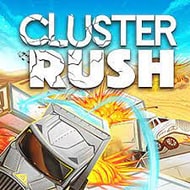
You jump too early and land between two container trucks as they pull apart, dropping into the gap before the next cluster forms. It’s not that you couldn’t see it coming — you could, clearly — but the truck spacing looked stable until the exact moment it wasn’t, and by the time you registered the separation, your jump arc was already committed. Cluster Rush is built almost entirely on that single gap between “the trucks look safe” and “the trucks are no longer safe,” and it exploits it with timing windows that compress dramatically in later levels.
| Genre |
Platformer / Arcade |
| Platforms |
Browser, Mobile |
| Controls |
Space bar or tap to jump |
| Mechanic |
Jump between moving trucks |
| Objective |
Reach the finish without falling |
The Truck System and Why the Clusters Matter
Cluster Rush puts the player on top of a convoy of trucks racing down an endless highway. The trucks are not in a single fixed formation — they cluster together and spread apart rhythmically, forming momentary safe landing zones and then gaps wide enough to fall through. The player character runs on top of the trucks automatically and jumps when prompted, and the jump must land on a truck surface rather than in a gap between trucks or off the sides of the convoy.
The “cluster” in Cluster Rush refers to the way multiple trucks temporarily group together close enough to hop between easily. During a cluster phase, the tops of the nearby trucks form a rough platform that the player can navigate across. During the spread phase, those same trucks are too far apart to bridge with a single jump. The rhythm of cluster and spread is not random — it follows patterns that repeat within level sections — but those patterns are complex enough that new players cannot distinguish them without several repetitions of the same section.
Truck types vary across levels and affect the usable surface area available for landing:
- Container trucks — large rectangular tops that provide the most stable and wide landing surface. The dominant truck type in early levels.
- Flatbed trucks — lower-profile trucks with narrower tops. Less landing area but often the only available surface in tight sections where containers haven’t appeared.
- Box trucks — medium-height trucks with angled corners that affect which direction a character slides after landing on the edge. Landing cleanly on a box truck top requires centering the jump arc on the roof rather than the sides.
The game’s difficulty escalates by introducing these truck types in combinations that force the player to account for different surface heights within a single cluster — jumping from a container height to a flatbed height involves a downward arc that doesn’t fit the same arc geometry as a container-to-container jump.
Jump Timing — Why the Obvious Moment Is Wrong
The most common beginner mistake in Cluster Rush is jumping at the moment a truck gap becomes visually obvious. By the time a gap looks clear enough that jumping feels necessary, the gap is often too wide to bridge with a standard jump. The correct timing is earlier — jumping when the gap is still forming, before it’s fully evident, while there’s still enough horizontal distance between the trucks to land on the far side.
This early-jump timing is counterintuitive because it requires acting before the threat has materialized. It demands a specific predictive reading: watching the rate at which two trucks are separating rather than waiting for the separation to become a confirmed obstacle. Players who develop this predictive reading make significantly fewer mid-air deaths than players who jump reactively, because they exit the current truck surface while the destination surface is still close enough to land on.
The same logic applies in reverse for approaching gaps. When two trucks are closing together and a gap is narrowing, the jump timing to clear the gap is earlier than it looks — the gap will be narrowest briefly, then may widen again if the trucks’ speed differential reverses. Cluster Rush generates sections where the gap-timing windows are extremely brief and require this anticipatory approach rather than reactive response.
Level Progression and What Gets Harder
Cluster Rush is divided into numbered levels that increase in complexity through several different mechanisms. Early levels feature predominantly container trucks in simple cluster formations with clear rest surfaces between gap zones. By the middle levels, the convoy includes mixed truck types, gap zones appear more frequently and with less warning, and the truck separation rhythm becomes irregular within a level — sections of even spacing give way to erratic timing that forces continuous pattern reading rather than the memorized cadence that worked in simpler sections.
Later levels add moving hazards within the convoy itself: trucks with obstacles on their rooftops that the player must dodge while still managing the cluster and gap rhythm. A container truck with a cargo obstruction on its roof cannot be landed on in the same way as a clear container, forcing the player to jump over the obstruction or find a different landing surface. This adds a vertical layer to the horizontal timing problem and is where many players find Cluster Rush shifts from a timing game to a coordination game.
The specific level that most players identify as their first significant wall — the level that required far more attempts than any previous one — is typically in the mid-to-late section where erratic truck spacing combines with rooftop obstacles for the first time. Players who adapted to the cluster rhythm on early levels find that the erratic timing disrupts the cadence they built, and the rooftop obstacles add a decision layer they weren’t previously handling. Relearning the rhythm in that new context is the defining skill challenge of the Cluster Rush mid-game.
The Social Life of Cluster Rush
Cluster Rush has an unusually strong presence as a shared experience relative to its solo-play depth. The game became widely known through video content — specifically, through recordings of unexpected failures at difficult gap timings that read as comedic rather than frustrating. The moment a character commits to a jump arc, hangs in the air over a widening gap, and drops through in slow motion is visually satisfying in a way that makes failure into entertainment. This gave Cluster Rush a viral quality early in its distribution that extended its reach well past what its gameplay complexity alone would suggest.
The community that formed around Cluster Rush is primarily interested in level completion rather than optimization. Players compare first-completion attempts for specific levels and discuss which sections required the most retries. There is a smaller speedrun community focused on minimum-jump clears — completing levels using the fewest possible jumps, which requires very specific routing decisions about which trucks to skip and which cluster formations to wait for. Minimum-jump runs are substantially harder than first-completion runs because they require reading two or three clusters ahead to identify which formation supports the skipped-truck routing.
What Cluster Rush Gets Wrong — and the Community Knows It
The honest criticism of Cluster Rush is that it has a relatively short content lifespan for players who complete its primary levels. The game’s depth is in the timing skill rather than in the variety of its content, and once that timing skill has been developed through the main level set, there isn’t much to extend the experience. There is no editor, no procedural mode, no endless runner variation. Players who finish the levels and want more find that the game’s only response is replaying completed levels for improved times — a valid but limited replayability option compared to games that generate content indefinitely.
A secondary criticism concerns the difficulty of certain specific gap timings in later levels. Several sections include windows where the timing requirement is precise enough that a tenth of a second variance determines success or failure, and the game provides no visual feedback that distinguishes a timing failure from a positioning failure. Players who die at the same gap repeatedly sometimes genuinely cannot identify whether they are timing their jump correctly and landing in the wrong position, or timing their jump incorrectly and landing in the right position with insufficient momentum to bridge the gap. Better feedback on failure type would reduce the trial-and-error component that currently dominates the learning curve at those specific sections.
Questions About Cluster Rush
- Is there an infinite mode in Cluster Rush? The standard version of Cluster Rush features discrete numbered levels rather than an infinite mode. Completing all available levels exhausts the main content offering. Some browser host sites have added extended level sets or modified versions with additional content, but the core game is level-based rather than endless. Players looking for the same truck-jumping mechanic in an infinite format have explored other titles in a similar genre.
- Does the truck separation speed change within a single level? Yes — within a single level, truck separation and clustering rhythm is not constant. Levels are designed with segments of different separation tempos. Early segments in each level tend to use the more forgiving rhythm that the level introduced, while later segments within the same level speed up the separation rhythm or add irregular timing that disrupts the cadence built in the early segment. This within-level variation is what makes Cluster Rush levels feel harder than their opening section suggests.
- What is the most useful habit to develop for Cluster Rush performance? Watching the rate of separation rather than the size of the gap. The gap’s current size tells you where the trucks are now. The rate of separation tells you where they’ll be when your jump arc lands. Players who retrain their visual focus from gap width to separation rate improve faster than players who focus on perfecting jump timing to the current visual state, because the destination surface will be in a different position by the time the jump arc completes.
Cluster Rush earns its compulsiveness through the specific way it makes failure legible. The truck pulls away, the character drops through, and the reason is always visible in the replay: the jump was half a beat too late, or the target truck was already separating before the jump was committed. That legibility is what drives another attempt and another and another, until the cluster rhythms of a given level section are internalized to the point where the correct jump moment arrives before the gap fully forms, and the character lands cleanly on a surface that looked like it was already too far away to reach.