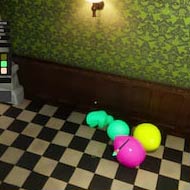
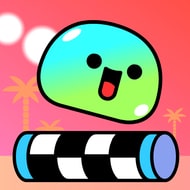
Meccha Chameleon 2 looks like a sequel with more content but plays like a sequel that questioned every assumption the original built. The Chromachain is still there. Meccha’s four-color cycle is still there. But the Prismatic Ocean zone submerges all of that in Chromawaves — timed pulses that change a segment’s color while the segment is already on screen — and the Starfield Summit introduces color gravity, where the direction gravity pulls affects which color segments are passable. Returning players from Meccha Chameleon will know the rotation order cold. Meccha Chameleon 2 bets that knowing the rotation order is no longer enough.
| Genre |
Arcade Puzzle / Reflex |
| Platforms |
Browser, Mobile |
| Zones |
6 (all original + Prismatic Ocean + Starfield Summit) |
| Levels |
60 total (10 per zone) |
| New Colors |
Lumos (fifth color, Starfield Summit exclusive) |
What Returns and What’s New
Meccha Chameleon 2 opens with the four original zones — Chromawoods, Crystalfall Cavern, Neon District, Sunburst Plains — rebuilt with revised level layouts and additional obstacle placements that reflect lessons learned from how players engaged with the original. The Chromawoods levels are slightly faster than their counterparts in the first game. Crystalfall Cavern introduces paired Mirror Lizards earlier in the zone than before. The Neon District is the area most changed: its triple-color segments now cycle faster, and a new obstacle type called the Prism Spike appears — a thin barrier that splinters into two colored fragments on contact, each flying in opposite directions and potentially disrupting the Chromachain through secondary collision.
Meccha’s design in the sequel has visible additions: the scales are more detailed, the color-shift animation between body colors now produces a brief ripple effect that traveling through a matching segment amplifies into a full-body flash. This visual change has a small gameplay implication — the ripple effect serves as a subtle additional indicator of the current color when the path is generating a lot of visual noise in the Neon District and Sunburst Plains zones. Players who found segment color reading difficult against the busy Neon District backgrounds report that the ripple indicator is noticeably helpful in Meccha Chameleon 2.
Lumina, a bioluminescent gecko introduced in Meccha Chameleon 2, is Meccha’s companion character rather than a playable character in the traditional sense. Lumina appears at specific points within levels — typically before a cluster of Chroma Voids or a dense Prism Spike section — and illuminates the upcoming obstacle arrangement for three seconds. This preview window functions as a “soft checkpoint” of information: players who read Lumina’s preview correctly know exactly what color they need to be and where the safe passage point is. Players who don’t recognize that Lumina has appeared are simply experiencing what they would have in the original. Lumina doesn’t change the game mechanically; she changes how much information is available to observant players.
The Color Blend Mechanic
Meccha Chameleon 2’s most significant mechanical addition is Color Blend. Tapping twice in rapid succession — within 0.2 seconds — activates a brief Blend state where Meccha’s scales display two colors simultaneously, flickering between them. During a Blend state, Meccha can pass through segments of either of the two blended colors. The Blend state lasts approximately 1.5 seconds before resolving to the second color tapped.
Color Blend adds a layer of decision complexity that the original game’s single-tap mechanic didn’t require. In the original, the question was always “which color do I need, and how many taps to get there.” In Meccha Chameleon 2, the question becomes “can I use a Blend to bridge two consecutive segments of different colors without a full cycle between them.” A segment cluster that runs Scarlet-Amber-Aqua in sequence can be cleared with the rotation (three taps between each) or with two Blends that bridge the color jumps. The Blend approach is faster but requires precise double-tap timing on each Blend activation.
The community’s early consensus on Color Blend is that it is most valuable in the Prismatic Ocean zone, where Chromawaves mean a segment’s displayed color changes between the time Meccha reads it and the time Meccha arrives at it. A Blend state’s two-color coverage acts as a hedge against a wave arriving during approach — if the wave shifts the segment to the other blended color, the Blend still covers the match. This is the technique the community calls “wave hedging,” and it’s considered one of the more sophisticated applications of the new mechanic.
Prismatic Ocean — Chromawaves and Reading the Pulse
The Prismatic Ocean zone (levels 41 through 50) is the first genuinely new content in Meccha Chameleon 2, and it establishes that the sequel intends to build on the original’s mechanics rather than simply expand them. Chromawaves are visual pulses that travel along the path ahead of Meccha, changing the color of each segment they touch when they pass through it. A Scarlet segment becomes Aqua when a Chromawave passes; an Aqua segment becomes Amber; and so on, cycling in the same rotation order as Meccha’s own color tap. A second Chromawave following the first advances each segment’s color again.
The core reading challenge in Prismatic Ocean is predicting where each Chromawave will reach by the time Meccha arrives at the corresponding segment. At the start of level 41, Chromawaves move slowly enough that their position relative to each segment is readable with standard visual tracking. By level 47, Chromawaves move faster than comfortable visual tracking allows, and players must shift from watching wave position to counting wave frequency — knowing that a fast-wave level will have advanced each segment by two steps from its displayed color by the time Meccha reaches it, and preparing accordingly.
Prismatic Ocean is the zone where Color Blend proves its depth. Hedging one Blend against an uncertain Chromawave position is the correct play for segments where the wave position is ambiguous, and learning exactly how far in advance to initiate a Blend for maximum wave-uncertainty coverage is a skill that Meccha Chameleon 2 explicitly develops across ten levels rather than asking players to figure out independently. The zone’s level design is the most deliberately skill-building content in either game in the series.
One acknowledgment the community has raised about Prismatic Ocean: level 49 is widely considered too hard relative to level 48. The difficulty step between these two levels is significantly steeper than any equivalent step in the original game’s zone design, and players who clear level 48 comfortably often find themselves stuck on level 49 for a disproportionate number of attempts before the Chromawave reading skill required snaps into place. This is not a universal complaint — some players find the jump invigorating — but it appears consistently enough in community discussions to qualify as a genuine difficulty calibration issue.
Starfield Summit — Color Gravity and Lumos
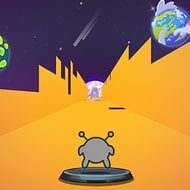
The Starfield Summit (levels 51 through 60) is Meccha Chameleon 2’s final zone and its most conceptually ambitious. Color gravity changes which segment colors are passable based on the current gravitational direction. When gravity pulls downward (the standard state), Scarlet and Aqua segments are passable in their normal matching rule. When gravity inverts, Amber and Violet segments become passable and Scarlet and Aqua block. Gravity toggles at fixed intervals in each level — the interval is level-specific and must be learned per level rather than inferred from a global rule.
Lumos, the fifth color exclusive to Starfield Summit, behaves independently of gravity — Meccha’s Lumos body color allows passage through Lumos segments under any gravitational state. Lumos is not in the four-color cycle tap; it is accessed only through a Lumos Star collectible that appears at specific points in Starfield Summit levels. Collecting a Lumos Star switches Meccha’s color to Lumos and keeps it there until a gravity inversion occurs or until another color is tapped. The presence of Lumos segments distributed through Starfield Summit levels creates windows where collecting the Lumos Star and navigating to the Lumos segments before a gravity inversion is the highest-efficiency path through a section.
The community calls Starfield Summit’s core decision “gravity reading” — the practice of tracking the current gravity state, knowing how many seconds until the next inversion, and planning color decisions accordingly. Gravity reading combines with Chromachain awareness, Color Blend timing, and Lumos Star routing to produce the highest decision density per second of any zone in either game. Experienced Meccha Chameleon 2 players describe level 55 — the first level where all of these systems appear simultaneously — as the genuine skill threshold of the sequel, equivalent to what Neon District level 24 was in the original. Players who can clear level 55 with a Chromachain above 25 have demonstrated full system integration.
Spectrum Surge and Power-Up Changes
Meccha Chameleon 2 carries over the original’s three power-ups (Color Lock, Rainbow Burst, Chromashield) and adds Spectrum Surge — a three-second window where Meccha displays all four colors simultaneously in a cycling shimmer and can pass through any segment of any color. Unlike Rainbow Burst, which suspends the Chromachain, Spectrum Surge allows the Chromachain to continue accumulating during activation. This makes Spectrum Surge significantly more valuable for score optimization than Rainbow Burst, despite both being color-restriction-removal tools.
The community debate around Spectrum Surge is interesting: some players consider it too powerful for competitive use, arguing that it trivializes the Chromachain decision-making that is the game’s core skill expression. Others argue that Spectrum Surge’s rarity — it appears in only 8 of the 60 levels, and only once per level — makes it a situational tool rather than a dominant strategy. The competitive community has developed separate scoring categories for Spectrum Surge-inclusive and Spectrum Surge-excluded runs, which sidesteps the debate while giving players who prefer the purer experience a separate leaderboard to compete on.
What Changed Between the Two Games — and What Didn’t
The most significant continuity from Meccha Chameleon to Meccha Chameleon 2 is the Scarlet-Aqua-Amber-Violet rotation. This four-color cycle, in exactly this order, remains the backbone of the sequel’s mechanics just as it was in the original. Color Blend doesn’t change the rotation — it adds a two-color overlap window within the same cycle. Color gravity doesn’t change the rotation — it changes which colors in the rotation produce a passable result. Chromawaves advance segment colors using the same rotation logic. The decision to keep the rotation unchanged is the correct one: the original game spent 40 levels making this rotation feel natural, and the sequel’s challenge systems all build on that familiarity in specific ways.
The most significant change is the information density per level. Meccha Chameleon levels asked players to track their current color and the segment ahead. Meccha Chameleon 2 levels at their peak ask players to track their current color, the Chromawave position, the gravity state and inversion timer, Lumina’s preview (if she appeared), available Color Blends, and active power-up state simultaneously. This is a meaningful increase in cognitive load that the game manages through its zone structure — each zone introduces one additional tracking demand and provides 10 levels to integrate it before the next is added. The result is a game that feels challenging but logical rather than overwhelming.
Questions About Meccha Chameleon 2
- Do saves from Meccha Chameleon carry over to the sequel? Meccha Chameleon 2 does not import save data from the original. The sequel’s level progression, power-up collection, and Challenge Mode unlocks begin fresh. Character skins unlocked in the original are not available in the sequel — Meccha Chameleon 2 has its own skin unlock system tied to in-game achievement milestones rather than original-game completion status. Players who complete both games maintain separate score records for each.
- Is Lumos accessible outside of Starfield Summit? Lumos is exclusive to Starfield Summit. No Lumos Stars appear in any other zone, including the rebuilt versions of the original zones. This decision was deliberate — Lumos as a concept (a gravity-independent fifth color) would disrupt the original zones’ balance, which was calibrated for four-color play. The exclusivity also gives Starfield Summit a distinct identity beyond being mechanically more complex than earlier zones.
- What happens if a Chromawave reaches a Mirror Lizard in Crystalfall Cavern? Meccha Chameleon 2’s rebuilt Crystalfall Cavern does not include Chromawaves — that mechanic is exclusive to Prismatic Ocean. Mirror Lizards in the rebuilt Crystalfall Cavern behave identically to the original. The question is reasonable because some players wonder if Chromawaves exist globally; they don’t. Each zone’s mechanical vocabulary is scoped to that zone, which is part of why each zone’s first level functions as an implicit reintroduction to that zone’s specific ruleset even for players who completed all 60 levels on a previous run.
Meccha Chameleon 2 earns its existence as a sequel by finding systems that extend the original’s color-switching core without diluting it. The Prismatic Ocean’s Chromawave reading, the Starfield Summit’s gravity tracking, Lumina’s preview windows, Color Blend’s two-color coverage — none of these change what it feels like to tap a key and watch Meccha’s scales shift from Amber to Violet just before a Violet gate closes. They change the context around that tap, expanding the number of factors the correct tap decision must account for. Players who finished Meccha Chameleon because they love that one-tap moment will find sixty levels of Meccha Chameleon 2 designed to honor it and challenge it at the same time.