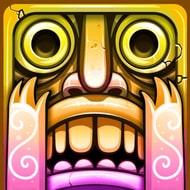
In Temple Run 2 Holi Festival you start with Guy Dangerous on a pathway being showered in colored powder, which matters because the Holi visual event isn’t decorative — the powder clouds reduce momentary visibility in a game that already demands reading obstacles further ahead than it feels comfortable doing. Players who treat the Holi Festival theme as a purely aesthetic update discover its practical implication the first time a burst of magenta powder arrives ahead of a root obstacle and they don’t see the root until it’s too late to slide under it.
| Genre |
Endless Runner / Casual |
| Platforms |
iOS, Android |
| Setting |
Holi Festival color event (Temple Run 2) |
| Characters |
Guy Dangerous, Scarlett Fox, Barry Bones, Montana Smith, and others |
| Key Power-Ups |
Coin Magnet, Shield, Boost, Mega Coin, Head Start |
What the Holi Festival Event Changes
The Holi Festival version of Temple Run 2 applies a seasonal visual overhaul to the standard Temple Run 2 game structure. The pathway surfaces are decorated with colored powder patterns — yellow, red, green, and blue. Character models are splashed with powder pigments. Periodic powder-burst events send clouds of color across the screen, briefly limiting visibility through the standard path view. These visual elements sit on top of the core Temple Run 2 mechanics, which remain unchanged from the base game.
The practical difference is that obstacle reading — which in standard Temple Run 2 happens comfortably a few meters ahead — becomes slightly compressed during powder bursts. Players who have developed strong base-game habits find the Holi Festival version manageable but acknowledge that the visibility reduction adds a small element of reflex-testing that the standard version doesn’t have in equivalent form. The color explosions aren’t timed to obstacle placements, which means they can obscure obstacles in a genuinely random way rather than as a designed challenge.
Core Obstacle Types and Their Required Actions
Temple Run 2 Holi Festival uses the same obstacle set as the standard Temple Run 2, with each obstacle requiring a specific input:
Roots — low obstacles across the path. The required action is a swipe down (slide), which drops the character into a low-running stance that passes beneath the roots. The most common beginner error with roots is swiping too late — by the time the root is visually prominent, the slide window is closing. Roots require anticipation rather than reaction.
Fire barriers — waist-height fire obstacles that require jumping over. A swipe up sends the character into a jump arc that clears the fire. Combining a jump with a subsequent slide — to clear a fire followed immediately by a root — is a specific double-input that trips players who have only practiced individual obstacle types.
Falling platforms — sections of the path that are missing or broken, requiring jumps to cross. Gap sizes vary: small gaps can be crossed with a standard jump; large gaps require a jump activated further back on the approach path to achieve the necessary arc length.
Turning paths — sections where the path turns left or right abruptly. Swiping in the correct direction at the turn keeps the character on the path; missing the swipe or swiping the wrong direction sends the character off the edge. Turns are flagged visually by the path geometry changing direction ahead, but at high speed the visual warning and the required swipe input are very close in time.
Rotating logs — horizontal logs crossing the path at knee height. The character must jump over them. Logs that appear in pairs require consecutive jumps, and the spacing between the jumps is specific enough that the second jump must be input before the character has fully landed from the first.
The difficulty of Temple Run 2 Holi Festival scales with speed, which increases throughout the run as distance accumulates. At low speed, each obstacle type is readable far enough ahead to respond deliberately. At high speed, multiple obstacles of different types can appear in rapid succession, and the required inputs become a fast sequence rather than individual decisions.
Power-Ups and How to Use Them Effectively
Temple Run 2 Holi Festival’s power-up system is the core of score optimization. Power-ups are found on the path surface or purchased with coins for activation at the start of a run. Each power-up has a distinct role:
Coin Magnet — draws nearby coins to the character automatically for a duration. Eliminates the need to steer toward coins, allowing full attention to obstacle avoidance. The most consistently useful power-up for score improvement because it affects every second of a run rather than specific moments. Players who activate Coin Magnet at the run start and upgrade its duration get the most total coins per run.
Shield — provides one-collision immunity. The shield absorbs the next obstacle hit that would end a run and continues. Pairs well with runs where the player intends to attempt maximum speed rather than play conservatively. The Shield does not regenerate — it absorbs one hit and then the run continues without protection.
Boost — dramatically increases running speed for a duration, simultaneously granting a score multiplier. Boosts are most valuable when activated in sections with high coin density, because the combination of speed and multiplier accumulates coins rapidly. Activating a Boost in a section with many turns or obstacles at close spacing is a common error — the speed increase compresses reaction time exactly when obstacle density would benefit from more time.
Head Start — begins the run at a distance ahead of the starting position, skipping the slow early section and starting directly at a higher speed with an established score base. Useful for players who find early runs slow and unproductive; less useful for players who use the early section to build pattern familiarity before speed increases.
Character Selection and Speed Differences
Temple Run 2 Holi Festival’s characters are primarily distinguished by cosmetics and associated bonus effects. Guy Dangerous is the default. Scarlett Fox, Barry Bones, Montana Smith, Francisco Montoya, Zack Wonder, and Karma Lee are unlockable through coins or special events. In the Holi Festival event specifically, some characters have enhanced coin bonus rates or additional power-up duration bonuses tied to the event theme. The character bonus percentages affect long-run score optimization but don’t change the core obstacle mechanics — running as Scarlett Fox versus Barry Bones plays identically in terms of movement and obstacle avoidance requirements.
The practical effect is that character choice is most important for players focused on score per run rather than players focused on survival distance. For survival-focused play, any character is equivalent. For score optimization, characters with coin bonus rates outperform others on equivalent runs, and characters with power-up duration bonuses benefit specifically in runs where power-up chains are being actively managed.
Questions About Temple Run 2 Holi Festival
Players frequently ask how the Holi Festival version compares to standard Temple Run 2 in terms of difficulty. The honest answer is that they are functionally equivalent in obstacle mechanics and require the same core skills. The Holi powder clouds add marginal visibility disruption that experienced players adapt to within a few sessions. If anything, the Holi version is slightly more accessible to new players because the color-themed environment provides stronger visual contrast on certain obstacle types against the decorated path surface.
Another common question concerns whether the Holi Festival event content remains available year-round or only during the festival period. Availability has varied between releases — some Temple Run 2 versions have locked event content to specific calendar periods, while others have made festival themes permanently available through the game’s theme selection. Players who encountered the Holi Festival version during its active event period and want to return to it should check the current version of Temple Run 2 for theme availability, as the schedule differs between platform versions.
A legitimate criticism that surfaces about Temple Run 2 Holi Festival is that the event theme doesn’t substantively change the gameplay in a way that justifies replaying the game for returning players who have already mastered the base mechanics. The powder explosions are aesthetically charming but mechanically thin as a gameplay addition. The highest-engaged players with Holi Festival are those who use it as their primary introduction to Temple Run 2 rather than returning veterans. For the latter group, the festival theme is a cosmetic refresh rather than a new experience.
Temple Run 2 Holi Festival is the most visually joyful version of Temple Run 2’s obstacle course, and that visual joy has a genuine effect on new players who encounter it as their entry point. Guy Dangerous sprinting past powder-bursting blue and yellow clouds, swiping under a root just as a burst of red powder catches the screen, jumping over a fire barrier at the moment a green cloud clears — these moments create a specific sensory energy that the standard Temple Run 2 palette doesn’t produce. The obstacle course underneath those powder bursts is the same demanding runner it always was, and players who stay with it long enough to develop slide timing and jump sequencing as habits find that the Holi Festival version gives them exactly what the base game provides, with an additional layer of color that makes every run slightly more memorable than it would be otherwise.