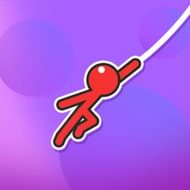
What happens when you release the hook at exactly the wrong moment in Stickman Hook? The stickman flies on a trajectory determined entirely by the angle and speed at the release point — and if those two variables weren’t what the level needed, there’s nothing to correct it. The hook doesn’t follow you; it disappears the moment you let go. Stickman Hook teaches a specific physical intuition: that the moment before release is the moment that matters, and every swing before it is just setup for that moment.
The Hook Mechanic — Release Timing as the Core Skill
Stickman Hook places the stickman character at the start of a level. Yellow circular hook points are embedded in the level geometry — walls, platforms, ceilings — at varying positions. Tapping the screen causes the stickman to launch a grappling hook toward the nearest hook point, connecting to it and beginning a pendulum swing around that anchor. Releasing the tap causes the stickman to fly in the direction of its current swing velocity. The next hook point must be reached from that airborne trajectory.
The pendulum physics is realistic enough to reward actual intuition about swing arcs rather than requiring memorized button sequences. A stickman at the bottom of a swing arc has maximum speed but is moving horizontally. A stickman higher in the swing arc is moving more vertically but slower. Releasing at the bottom launches the stickman in a fast, flat trajectory. Releasing higher in the arc launches them in a slower, more angled trajectory that gains height. The correct release point for any given swing depends entirely on where the next hook point is positioned relative to the current trajectory.
This means the primary skill in Stickman Hook is spatial — reading the geometry of the level and identifying which point in the current swing arc produces a trajectory that reaches the next hook point. Players who have developed strong intuition for this can identify the release point before they’ve fully completed a swing, which is the key to smooth, uninterrupted chaining across multiple hooks in sequence. Players still developing the skill tend to overshoot or undershoot and lose momentum, requiring an awkward grab at a non-ideal hook point to restart forward progress.
Level Geometry and How It Creates Challenge
Stickman Hook’s levels are built from colored block platforms and hook point distributions that create specific geometric challenges. The variety of challenge types across the 100+ main levels includes:
- Long gap traversals — wide horizontal distances between hook points where the stickman must achieve maximum swing speed before release to cover the distance. These require using the full bottom-arc release for maximum horizontal velocity and accepting that the trajectory will be nearly flat.
- Height challenges — hook points positioned significantly above the current trajectory, requiring the stickman to release from high in the arc on an upward swing to gain height for the attachment. These require releasing before the natural apex of the swing, which is counterintuitive when the instinct is to wait for maximum height.
- Narrow corridors — sections where the stickman must thread between obstacles on a precise trajectory. A release point one degree off either direction sends the stickman into a wall. These sections require a specific mid-arc release that produces a precise angle rather than the maximum-speed or maximum-height release that other sections favor.
- Chain sequences — multiple hook points in rapid succession where the release time between each hook is under half a second. These require trusting automatic swing mechanics to establish the next hook attachment because there isn’t time for deliberate targeting. Players who successfully chain these sections describe it as “letting the swings happen” rather than actively controlling each one.
- Ceiling hook traversals — sections where all hook points are on the ceiling, requiring the stickman to swing beneath them like a series of overhead monkey bars. The physics here are different from wall-mounted hooks because the pendulum arc is inverted — the stickman can gain backward momentum that helps clear gaps in the opposite direction.
The most difficult levels combine multiple challenge types in a single sequence. A long gap traversal immediately followed by a narrow corridor requires a full-speed release for the gap and then an immediate angle adjustment for the corridor — two consecutive release decisions that don’t share the same optimal release point, requiring the player to select one hook for gap clearance and another for corridor angle.
The Three-Star System and Why It Matters
Stickman Hook awards up to three stars per level based on the efficiency of the completion. One star for completing the level. Two stars for completing it with a time or efficiency threshold. Three stars for the most efficient completion — typically the fastest time or the fewest hook uses, depending on the level’s design objective. Three-star completions require finding the optimal path through the level rather than any viable path.
The three-star system significantly extends the game’s depth because optimal paths are often not the safest paths. A two-star completion might use five hook connections across a challenging level. A three-star completion of the same level might use three connections via a more difficult trajectory that covers the level in fewer swings but with smaller error margins. Players who complete all levels at one star and then pursue three-star ratings encounter a second, harder game within the same level geometry — one focused on efficiency rather than survival.
The community treats three-star completion of all levels as the true completion of Stickman Hook, not just reaching the end of the level list. Players who have three-starred all main levels typically move to challenge levels and speed-run attempts, where the emphasis shifts from efficient routing to maximum swing speed within an optimal route. Speed-run attempts require consistent three-star routing while minimizing the time between hook attachments to the point where each swing phase is as short as the physics allows without losing the trajectory needed for the next attachment.
Character Skins and the Visual Variety
Stickman Hook includes a collection of character skins that reskin the stickman visually without changing movement physics. The skins include variations on the base stickman design — different colors, patterns, and novelty shapes. Some skins are unlocked through achievement milestones; others are available through specific completion rates. None of the skins affect swing physics, hook attachment speed, or trajectory calculations. The choice of skin is purely aesthetic.
The community is divided on whether the skin system adds meaningful depth to Stickman Hook. Players who focus on three-star completion and speed-running rarely engage with the skin system beyond the default stickman. Players who play more casually and share session recordings often choose skins for visual distinctiveness in recorded content. The skin system’s presence doesn’t harm the core experience, but players who approach Stickman Hook for its physics puzzles find it a peripheral element rather than a meaningful addition to the gameplay.
Difficulty Progression Across the Level Set
Stickman Hook’s level set is sequenced to introduce mechanics gradually. Early levels have widely spaced hook points, simple horizontal traversal, and large error margins — a release that’s slightly off the optimal angle still reaches the next hook point because the points are close enough to allow imprecision. Mid-game levels introduce height challenges, narrower corridors, and longer gaps that begin to punish the imprecision that worked in early levels. Late levels and challenge levels apply the full mechanical vocabulary simultaneously with minimal error margin.
The specific transition point where most players first find Stickman Hook genuinely challenging is around the introduction of ceiling hook traversals. The inverted pendulum feel of ceiling hooks is different enough from floor and wall hooks that players’ established intuition for swing arcs produces incorrect release predictions. The stickman released from a ceiling hook at what feels like the correct angle often flies in an unexpected direction because the reference frame for “up” and “down” has inverted. Players need approximately ten to fifteen level attempts on ceiling-hook sections before their spatial model updates to account for the inverted geometry.
One honest criticism of Stickman Hook’s difficulty curve is that it becomes inconsistent in the later levels. Some levels that appear after the challenge level introduction are easier than levels that came earlier in the main sequence, suggesting that the difficulty ordering wasn’t fully recalibrated after later levels were added. This produces occasional frustration for players who hit a difficult late-game level after several easier ones, expecting continued escalation rather than variance. It doesn’t significantly harm the overall experience but does produce occasional “why is this here” moments that a tighter difficulty curation would eliminate.
What Advanced Stickman Hook Players Talk About
The advanced Stickman Hook community focuses on three areas: three-star routing, speed-run record attempts, and challenge level completion. Three-star routing discussions center on which hook sequences are optimal for specific levels — often finding paths that skip hook points the level seems to require, using longer swing arcs to cover ground that two shorter swings would handle. Speed-run attempts for specific levels are timed and compared between community members, with discussions about which physics quirks allow faster hook attachment timing.
Challenge levels are the most active discussion topic. These are levels designed specifically for experienced players, with tighter corridors, longer gap distances, and hook point placements that leave less margin for timing error than any main-game level. The community catalogs which challenge levels require specific techniques — ceiling traversal, minimum-attachment routing, long-gap speed release — and provides guidance for players attempting them. Some challenge levels have completion rates low enough that first-time clears are noted by community members.
Questions About Stickman Hook
- Is there a way to aim the grappling hook in Stickman Hook? The grappling hook automatically attaches to the nearest valid hook point within range when the tap is held. There’s no manual aiming — the game identifies the closest hook point and the hook goes there. Positioning the stickman correctly before tapping determines which hook point gets targeted, so “aiming” in Stickman Hook means positioning during the previous swing rather than manual targeting during the attachment.
- Can levels in Stickman Hook be replayed after completion? Yes — all completed levels remain available for replay at any time. This is how the three-star pursuit works: players complete levels on first attempt (often at one or two stars) and return to them specifically to improve their rating. Replaying levels is also how most players develop the intuition for optimal swing physics — the same level geometry presents different challenges when the objective shifts from “survive to the end” to “minimize time and hook count.”
- What causes the stickman to fall through hook points sometimes without attaching? The hook attachment requires the stickman to be within the active radius of a hook point when the tap input registers. At high swing speeds, particularly in long-gap traversal sections, the stickman can pass through a hook point’s visual position faster than the tap input is processed, resulting in a missed attachment. This is the most common source of “unfair feeling” failures in Stickman Hook, and experienced players compensate by tapping slightly earlier than the visual hook point position suggests — allowing the input-to-attachment delay to resolve while the stickman is still within the attachment radius.
Stickman Hook earns its dedicated following by building a game entirely around one beautiful mechanical question: at exactly which point in this swing do you let go? That question doesn’t have a fixed answer — it changes every time the hook point is in a different position, every time the corridor narrows differently, every time the ceiling becomes the floor. The stickman flies on whatever arc the release produced, and the satisfaction of watching that arc carry cleanly from one hook point to the next without touching a wall or dropping into a gap is specific to Stickman Hook in a way that no amount of other games can replicate. The release moment is the game, and every swing before it is practice.