What separates a good Electron Dash run from a failed one isn’t reflexes — it’s the moment you stop reading individual obstacles and start reading the lane pattern three positions ahead. Players who make it deep into a run aren’t reacting to each barrier as it arrives; they’ve built a moving picture of the next few seconds and they’re navigating inside that picture while the visible screen catches up to what they already know is coming.
Three Lanes, One Direction, No Stopping
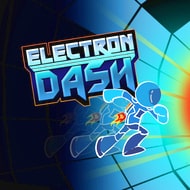
Electron Dash is a lane-based endless runner set inside neon-lit tunnels. The player controls an electron sprite moving forward automatically through a corridor divided into three parallel lanes: left, center, and right. Obstacles appear as glowing rectangular barriers across individual lanes. The player’s only inputs are switching between lanes — one tap to move left or right — and the goal is to travel as far as possible without colliding with a barrier.
The neon aesthetic of Electron Dash is functional as well as visual. The tunnel walls and obstacles glow in distinct colors against a dark background, which makes barrier positions clear even at high speeds. Colors in the environment also signal upcoming events — specific color pulses in the tunnel walls precede higher-density obstacle sections, giving players who have learned those signals a half-second more preparation time than players who rely on seeing the barriers themselves.
Lane switching in Electron Dash is instant — there is no sliding transition between lanes, the sprite jumps immediately to the target lane on input. This means there is no timing element to a lane switch itself; the challenge is entirely in choosing which lane to switch into and when. Players who make suboptimal lane choices consistently find themselves in the wrong position for the obstacle after the one they were trying to avoid, which is where most mid-to-high-distance deaths occur in Electron Dash.
Obstacle Patterns and Lane Priority
Electron Dash generates obstacles in patterns rather than as individual random barriers. A single barrier blocking the left lane is almost always followed by either a complementary barrier in the right or center lane, or by a clear section before the pattern repeats. Recognizing these pattern units — the two or three obstacle arrangements that cycle through a given difficulty phase — is the key skill that distinguishes players with consistent high scores from players who plateau at moderate distance.
Lane priority is the practice of defaulting to a specific lane position during open sections between obstacle clusters. Most experienced Electron Dash players maintain a center-lane default — not because the center lane is safer in any absolute sense, but because a center position maximizes available response options. From center, one switch reaches either the left or right lane. From either side lane, one switch reaches center but a second switch is needed to reach the opposite side. At high speed, the extra switch to reach an opposite-side lane is sometimes not available within the window before the obstacle arrives.
The obstacle density in Electron Dash increases across the run in distinct phases. New clusters of obstacles appear where previously there were longer gaps, the barrier spacing within clusters tightens, and patterns that were readable at the previous phase speed become only marginally readable at the new phase speed. Players who cannot identify when a new phase has begun — who continue applying the slower-phase reading strategy to the faster phase — typically die in the first cluster of the new phase without understanding why their approach failed when it was working moments before.
Power-Ups and When to Use Them
Electron Dash includes several power-up types that appear along the run path:
- Shield — provides temporary invulnerability to one obstacle collision. The shield does not stack — collecting a second shield while the first is active does not extend or stack protection. The shield is most valuable immediately before a high-density obstacle cluster, but since those clusters aren’t always flagged visually before they begin, experienced players often collect shields as they appear and hope the timing is favorable.
- Magnet — draws collectible items toward the sprite automatically for a duration. This reduces the need to chase items into lane positions that conflict with obstacle avoidance, which is where most players lose score efficiency in the mid-game.
- Boost — briefly increases forward speed for a score multiplier. The boost is the most dangerous power-up to activate during an obstacle-dense section because the increased speed compresses the reading window further. Players who collect boosts during clear sections and carry the multiplier into dense sections get the best value from them.
Power-up collection has a tricky interaction with lane management. A power-up in the right lane is attractive, but collecting it requires moving right — and if the next obstacle is in the right lane, the collection move puts the player in the worst possible position. Learning to evaluate whether a power-up is worth the lane position it requires, given the obstacles visible ahead, is one of the higher-level habits that separates advanced Electron Dash players from intermediate ones.
Why Electron Dash Rewards a Different Kind of Attention
The neon tunnel setting of Electron Dash creates a specific visual environment: high contrast, high brightness, with relatively minimal background clutter compared to games set in naturalistic environments. This reduces visual noise in a way that’s relevant to performance — there is less background information competing for attention with the obstacles. Players who struggle with lane-based runners in other visual settings often perform better in Electron Dash specifically because the signal-to-noise ratio in the visual field is higher. The dark tunnel and glowing obstacles make the relevant information the most visually prominent thing on screen rather than something that has to be extracted from a busy background.
This is not a trivial advantage. Many runner games place informative obstacles against similarly colored or moving backgrounds that create figure-ground ambiguity at high speed. Electron Dash’s black background and neon obstacles eliminate that ambiguity, which means the cognitive effort that would go toward separating obstacle from background can go entirely toward reading the obstacle pattern. Players who find runner games difficult partly for perceptual reasons — who have trouble tracking relevant objects against complex backgrounds — often find Electron Dash substantially more accessible than its difficulty level would suggest from description alone.
One limitation the community raises consistently about Electron Dash is the endgame depth. After the core lane-switching skill is developed and the obstacle phases have been learned, the game does not introduce meaningfully new mechanics. The later phases are faster and denser versions of the same patterns rather than genuinely new challenge types. Players who reach a high personal distance ceiling sometimes find that improvement stagnates not because they’ve hit a true physical skill limit but because the game has stopped offering new problem types to adapt to. This is a legitimate and honest limitation of the endless runner format applied to a limited mechanical vocabulary.
Electron Dash holds its appeal because the core skill it develops — reading lane patterns three positions ahead in a high-contrast visual environment — is genuinely satisfying to improve at, and the improvement is clearly visible in each session’s distance record. The electron sprite navigating through glowing barriers in the dark tunnel doesn’t require understanding a complex system or managing multiple mechanics; it requires building one very specific perceptual habit and then learning to apply it faster. For players who find that habit worth developing, Electron Dash provides exactly the right environment to do it in — clean, focused, unambiguous, and always willing to start again from the beginning whenever the pattern reading falls behind the speed.