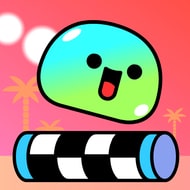
Candy Jump looks like a game for children but plays like a precision timing exercise with better aesthetic choices than most precision games bother to make. The platforms made of lollipops and layered cake slices look soft and forgiving. They are not. A jump with slightly off timing drops the character between two candy platforms, and the fall is just as permanent here as in any other vertical hopper. Candy Jump’s cheerful coating doesn’t soften its demands — it makes you forget to take them seriously until you’ve fallen twice from the same platform gap.
The Hop System and Vertical Progression
Candy Jump is a vertical hopper where the player character travels upward through an endless series of candy-themed platforms. Tapping the screen makes the character jump. The character will continue jumping automatically in many versions, with the player’s input determining timing and direction rather than whether the jump happens at all. Platforms are arranged in patterns across the available screen width, and the character must land on each platform on the way up to continue progress.
Platform gaps vary in size and position. A gap too wide for a single jump requires a platform chain — landing on each available platform in sequence to cross the distance. A gap positioned at the edge of the screen requires a precise directional input to send the character horizontally enough to reach it. Some Candy Jump versions include a wraparound mechanic where a character jumping off the left edge of the screen reappears on the right — a feature that expands the available routing options but requires players to understand when wraparound is active versus when the character will simply fall.
Platform Types and the Candy Hierarchy
Candy Jump uses a visual vocabulary of sweet-themed platforms that function slightly differently:
- Lollipop platforms — circular candy platforms at standard height. These are the primary stable platform type. Standard jump height lands cleanly on a lollipop without any special timing consideration. Their circular shape means that edge landings sometimes slide the character off; centering the landing is worth the extra precision.
- Cake slice platforms — horizontal platform segments made of layered cake visuals. Slightly wider than lollipops, providing a more forgiving landing zone. The most beginner-friendly platform type in terms of landing margin.
- Candy cane rungs — thin horizontal rungs that appear at irregular intervals. Much narrower than lollipop or cake platforms, requiring more precise jump arcs. Candy cane rungs typically appear in sections where platform density is high but available landing area is compressed, making them the precision-test platform type.
- Licorice swings — in some Candy Jump versions, platforms that sway side-to-side while the character is airborne. Landing on a swaying licorice swing requires timing the landing to the platform’s position rather than its average location. The swing moves predictably in an arc, so its position at landing is calculable from its position at jump launch.
- Marshmallow clouds — soft platform types that appear in some versions with a slight bounce property. Landing on a marshmallow cloud produces additional upward velocity that extends the next jump’s height. This bonus height can be useful for reaching higher gaps but can also overshoot platforms that were within comfortable range of a standard jump.
The combination of different platform types within a single session creates a variety of jump timing decisions that keeps Candy Jump from becoming fully automatic even after extended play. A session that has been all lollipops and cake slices for the past thirty platforms suddenly introducing a candy cane rung or a licorice swing requires an immediate precision adjustment that catches players who have settled into a comfortable rhythm.
What Goes Wrong and Why
The most common mistake in Candy Jump is not imprecise jumping — it’s not reading which direction a jump needs to go until the character is already airborne. Because Candy Jump’s platform placement is procedurally arranged and the character is always moving upward, the decision about direction has to be made before the jump is committed, not during it. Players who look at the character and then look up for the next platform are already behind the timing required for accurate direction input.
The correct visual attention pattern is to keep the focus above the character’s current position while the character is in flight, reading the next landing platform’s position and the platform after it simultaneously. This forward-looking attention is a habit that takes deliberate development — the natural instinct is to watch the character, which provides maximum information about the current jump arc but minimum information about what the next jump needs to accomplish.
A second common error is height overestimation on platforms that require a half-height jump to reach a platform offset below the apex of the standard jump arc. Candy Jump sometimes positions a platform at a mid-arc height that the character passes through on the way up but overshoots if the jump is made at full height. Learning to make abbreviated jumps — tapping briefly rather than holding — is a skill that many players don’t realize they need until they’ve repeatedly overshot a platform at the same height they can clearly see.
Score and Progression
Candy Jump scores by height — the higher the character reaches, the more points accumulated. This creates a simple escalating loop where every session ends with a specific height score that becomes the reference point for the next session’s improvement target. Some Candy Jump versions include a coin collection system alongside height scoring: coins float between platforms and collecting them while navigating upward contributes to an unlockable reward system.
The combination of height and coin scoring creates a mild routing tension: the direct path upward maximizes height score, but coin collection sometimes requires lateral detours that slow height accumulation. Players who prioritize coin collection over vertical efficiency trade height score for coin rewards, which affects long-run progression speed but may reduce session peak heights. Most players optimize for height during regular sessions and adopt a more coin-focused approach during sessions specifically dedicated to unlocking content.
One honest limitation of Candy Jump’s progression system is that the procedural platform generation doesn’t escalate difficulty in a clearly felt way past the early game. Early sessions feel meaningfully different from experienced sessions, but within the mid-game the difficulty is relatively flat — new sessions play similarly to old ones, and personal best improvements come from sustained attention and consistency rather than mastery of new mechanics. Players looking for a clearly escalating difficulty curve often find Candy Jump’s middle and late sessions less engaging than its initial learning phase.
Questions About Candy Jump
Players frequently ask whether Candy Jump has an ending — whether the candy platforms run out at some height and the game declares a winner. There is no defined endpoint in standard Candy Jump versions. The platforms generate procedurally and the run continues indefinitely until the character falls. High-score targets are self-defined rather than game-defined; the game doesn’t signal that any height level represents completion.
Another common question concerns the character’s horizontal movement between platforms. Many players assume that horizontal position is automatically centered on each jump, but Candy Jump’s character maintains horizontal momentum between jumps in most versions. A character that jumped strongly to the right to reach a right-positioned platform arrives with rightward momentum that affects the arc of the next jump. Players who don’t account for this momentum find themselves consistently overshooting to one side after a strong lateral jump, because they’re applying the same correction they would if the character were perfectly centered.
The community has a mild but ongoing debate about whether the marshmallow cloud bounce mechanic is a net positive feature. Players who have adapted to its behavior find the extra height useful for reaching gap clusters that standard jumps struggle with. Players who haven’t adapted find the unexpected bounce a significant source of platform overshooting, particularly in sections where standard-height platforms are positioned just above a marshmallow cloud. The bounce magnitude isn’t enormous, but it’s large enough that players who treat the cloud as a normal platform consistently overjump immediately after landing on one.
Candy Jump delivers what it promises: a visually cheerful vertical hopper that is more demanding than it looks and more satisfying to improve at than candy-themed aesthetics suggest. The lollipop landing zones, the licorice swings, the marshmallow cloud bounces — they create a sensory environment that makes precision feel playful rather than stressful, which is a specific achievement in game feel that harder-looking precision games often miss entirely. Players who stick with Candy Jump long enough to develop consistent platform-read habits find that the candy coating isn’t hiding difficulty — it’s making the difficulty easier to return to after a fall, which might be the game’s most underrated design choice.