What does it feel like when the tunnel turns purple and the obstacles arrive faster than you can consciously register them? For the first twenty sessions of Tunnel Rush, it feels like failure. By session fifty, it feels like pattern recognition at a speed your conscious mind can’t access. That gap — between what you can react to and what you can recognize — is the territory Tunnel Rush lives in, and players who don’t understand that gap spend months stuck at the same score.
The Tunnel and How Speed Changes It
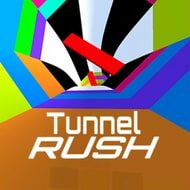
Tunnel Rush places the player inside a cylindrical tunnel that stretches forward in an infinite 3D perspective. The camera moves forward automatically at a speed that increases over time; the player’s job is to steer left or right to avoid the obstacles that materialize ahead. The tunnel rotates as well as advances, so the floor can become a wall or the ceiling without warning. Obstacles appear as geometric shapes — triangular dividers, rotating panels, circular rings with gaps — placed across the tunnel’s cross-section with varying frequency and gap size.
Speed in Tunnel Rush is not constant. There are speed phases — sustained periods of fixed velocity — and speed transitions, where the tunnel accelerates noticeably and the obstacle density increases. New players are often caught by speed transitions because the game gives very little visual warning before the pace changes. Players who are reading obstacles at the current speed suddenly find their reaction time insufficient for the next phase. This is a deliberate design choice, and recognizing the visual cues that precede a speed transition is one of the first skills experienced Tunnel Rush players develop.
The color changes that accompany speed phases are one such cue. Tunnel Rush cycles through different background color schemes as the run progresses, and experienced players associate specific color transitions with the incoming speed changes those colors precede. This is pattern recognition rather than visual reaction — by the time you can see that the obstacle is unavoidable, it’s already too late to steer. The players who get far are reading three to four obstacles ahead and responding to what they expect rather than what they see.
Obstacle Types and the Reading Strategy for Each
Tunnel Rush generates several distinct obstacle types, each requiring a different positioning approach:
- Triangle barriers — the most common type. A triangular divider splits the tunnel into two lanes. The gap is always at the edge of the triangle, and the tunnel’s rotation determines which edge is accessible. At low speed, rotation is slow enough to track visually. At high speed, it must be anticipated from the rotation rate observed several beats earlier.
- Panel sweepers — panels that rotate across the tunnel cross-section continuously. The gap in the panel’s rotation is fixed but the gap’s position relative to the floor changes as the tunnel itself rotates. Catching the gap requires knowing both the panel’s rotation state and the tunnel’s current tilt simultaneously.
- Ring barriers — rings with a single open gap positioned at varying points around the circumference. These are often the most forgiving at medium speed because the gap is relatively large, but at high speed they appear with minimal warning and the gap may be positioned away from the center, requiring lateral movement that conflicts with avoiding a preceding obstacle.
- Cluster sections — multiple obstacles close together, requiring consecutive positioning decisions without a recovery gap between them. Cluster sections are the most common site of run-ending deaths because the cognitive and physical load peaks without any breathing room for the player to reestablish a comfortable position.
Players who struggle specifically with cluster sections often improve most by shifting their attention from the immediate obstacle to the second or third obstacle in the cluster. Committing to a position for obstacle one without simultaneously reading obstacle two puts the player in a reactive mode that cluster sections specifically punish.
Left and Right Controls — and Why Most Players Overcommit
Tunnel Rush uses left and right controls only. There is no forward or backward movement, no jump, no brake. The entire player input space is a single axis of lateral movement within the tunnel’s cross-section. This simplicity is deceptive — a single-axis control scheme sounds straightforward until high speed compresses the decision time for each left-right choice to below a quarter second.
The most common technical error in Tunnel Rush is overcommitting to a directional input. Players who see a triangle barrier to their left move all the way right to clear it — and then immediately face the next obstacle that requires repositioning from a now-extreme right position. Tunnel Rush’s obstacles are generated with the assumption that players will maintain a roughly central position and make small corrections, not swing from edge to edge. Players who consistently overcorrect waste their available movement distance on the correction itself and arrive at the next obstacle out of position.
The correction is counterintuitive for players coming from slower-paced obstacle games: staying closer to center and using smaller movements is both safer and faster to execute than large lateral swings. This takes deliberate practice to ingrain because the instinct at high speed is to move decisively and fully away from visible threats.
The Dual Mode Variation
Tunnel Rush includes a dual mode in some versions where the player controls two balls simultaneously — one moving through the main tunnel and one moving through a mirrored tunnel below. Both balls use the same control inputs, so a left movement on the keyboard moves both balls left simultaneously. The dual tunnel layouts are designed such that a position that avoids an obstacle in one tunnel doesn’t always avoid the obstacle in the mirror tunnel, requiring players to find the position that clears both simultaneously.
Dual mode is significantly harder than single mode at equivalent speed. The cognitive load of tracking two obstacle streams plus the positional constraint of managing both balls with shared inputs compounds in a way that produces substantially lower scores than single mode for most players until their single-mode performance is strong enough that tracking a single obstacle stream has become genuinely automatic rather than deliberate. The community treats high dual mode scores as a separate achievement from high single mode scores rather than a direct comparison, because the skill demands are different enough to require separate development.
Why Tunnel Rush Gets Genuinely Addictive
Tunnel Rush has a specific psychological property that many faster-paced obstacle games lack: death is almost always unambiguous. Unlike games where a collision might be debatable — where the hitbox felt wider than it looked — Tunnel Rush kills the player with clear visual contact between the ball and an obstacle. This means death produces a clear information signal: you were in the wrong place at that specific moment. The game never feels random to experienced players, even at high speed. Every death is legible, which means every death is a recoverable piece of information about what the correct position should have been.
This legibility drives compulsive replay. Players don’t feel cheated by deaths in Tunnel Rush; they feel like they’ve identified the specific problem they need to solve. The session structure that emerges naturally — run, die, understand why, run again — is extremely low-friction. Restart time is under two seconds. There’s no loading screen, no menu navigation, no delay between recognizing the problem and attempting the solution. That tight loop is what makes Tunnel Rush the kind of game that produces unexpected hour-long sessions in players who sat down for ten minutes.
Accessibility and the Color Vision Issue
Tunnel Rush has one persistent accessibility issue that the community discusses regularly: the game’s color scheme changes are difficult to track for players with color vision deficiency, particularly protanopia and deuteranopia. The game uses color transitions as both aesthetic elements and gameplay cues for speed phase changes, and when those color changes are less distinguishable, the timing cues they represent become inaccessible. The current version does not include a color blindness mode, which is a meaningful gap given that the game is otherwise playable entirely by shape and timing rather than by color. This is a legitimate design criticism that hasn’t been addressed in the primary release.
Common Questions About Tunnel Rush
Is there an end to Tunnel Rush or does it run forever?
Tunnel Rush is an infinite runner with no defined endpoint. The run continues until the ball makes contact with an obstacle, at which point the session ends and the score — measured in meters or time depending on the version — is recorded. There is no ceiling on how far a run can go theoretically; the practical limit is determined entirely by the player’s ability to maintain accurate positioning as speed phases increase. Some browser versions add a score display in the corner that shows the current run distance alongside a personal best tracker.
Does playing Tunnel Rush at lower graphics settings affect the gameplay?
Lowering visual quality to improve frame rate can meaningfully affect the Tunnel Rush experience. At consistently high frame rates, the obstacle approach animation is smooth and the position of incoming obstacles is easier to read. At lower frame rates, obstacle positions can appear to jump frame-to-frame, which makes the reading strategy of anticipating positions ahead of time more difficult. Players using lower-end machines sometimes find performance improvements that translate directly into better run distances, because the obstacle legibility improvement outweighs any benefit from having more processing headroom available.
What is the fastest way to improve a Tunnel Rush high score?
The fastest improvement path for most players is not extended single sessions but distributed short sessions across multiple days. The pattern recognition that Tunnel Rush requires consolidates between sessions rather than within them — players who play for ninety minutes and then return twenty-four hours later often find their effective score ceiling is higher on return than at the end of the previous session. The specific obstacle patterns that ended runs in session one are stored somewhere faster than conscious recall between sessions, and the return session benefits from that consolidation. Tunnel Rush is a game that rewards weekly habit more than daily marathon sessions.
Tunnel Rush’s strongest sessions happen when players stop trying to react and start trying to predict. The tunnel changes color, the obstacles close in, and somewhere past the first fifty meters of any given speed phase the conscious decision-making fades out and the ball threads gaps that the thinking mind would have missed. That automatic recognition — obstacles clearing before you’ve fully registered them — is the state Tunnel Rush is designed to create, and once players have found it for the first time, the game’s compulsive draw becomes completely clear. Every subsequent run is an attempt to get back into that state faster, stay there longer, and push deeper into the tunnel’s accelerating dark before the first wall finds the gap in the pattern.