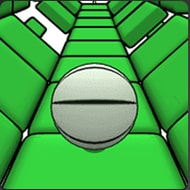
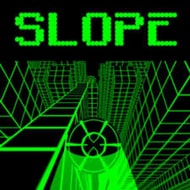
In Slope you start with a ball at the top of a neon-green grid, a slope that descends into the distance, and no instruction other than what gravity provides. This matters because the game never explains what’s coming. The first time the slope angles sharply to the right and the ball reaches the edge, new players feel ambushed. The second time it happens, they begin to understand that Slope is teaching them that the slope itself is not passive scenery — it is an active obstacle that changes the ball’s available movement space constantly.
The Ball, the Grid, and Forward Momentum
Slope puts a ball at the top of a procedurally generated 3D course built from rectangular platforms, ramps, and gaps arranged on a neon-green grid descending into the distance. The ball rolls forward automatically at increasing speed; the player’s only inputs are left and right to steer. There are no jumps, no brakes, no reversals. The ball falls off the edge of the playing surface or collides with a red obstacle and the run ends. The score is measured in distance traveled.
What the grid does that most obstacle games don’t is combine two simultaneous failure conditions: falling off the side of a surface and hitting an obstacle placed on it. These are different problems requiring different responses. An approaching obstacle requires a correction — move away from the obstacle to avoid it. An approaching edge requires the opposite — move toward the center to avoid going off the side. When an obstacle sits close to an edge, both failure conditions are active simultaneously, and the player must find a position that avoids the obstacle without drifting over the boundary. This two-condition problem is where Slope’s real difficulty lives.
Forward speed in Slope is not controlled by the player — it increases on its own as the run progresses. There is no sprint button, no throttle. The ball moves at whatever speed the current phase dictates, and that speed only goes up. This means that the input space available for any single correction shrinks continuously throughout a run. A correction that required half a second at the start needs to happen in a quarter second at the midpoint and an eighth of a second at the peak. Players who have not developed their steering efficiency — the ability to make small, precise corrections rather than large sweeping movements — find that their response time becomes inadequate as the run progresses even if their reaction speed hasn’t actually changed.
Platform Types and the Geometry of Close Calls
Slope generates several platform types that appear throughout a run:
- Wide platforms — full-width sections where the grid spans the entire available horizontal space. These appear in the early and mid-game and give players time to reestablish center position after a correction. Wide platforms are where long runs are built, because they allow recovery from the precision demands of the sections preceding them.
- Narrow bridges — sections where the platform width reduces to one or two grid units. The ball must be steered precisely along the bridge without touching either edge. At high speed, bridge sections require commitment to a straight path rather than any lateral correction, because even a small steering input at high speed moves the ball far enough laterally to go off a bridge edge.
- Split paths — the platform divides into two narrow strips with a gap between them. The player must choose which strip to take and hold that position. Split paths rarely appear without some obstacle on one of the two strips, making the choice between strips also a question of which obstacle is more manageable.
- Red obstacle clusters — rectangular red blocks placed on the platform surface. Single blocks are avoidable with standard steering. Clusters require reading the open path through multiple blocks in sequence, which at high speed means seeing and committing to a path several obstacle-widths in advance.
- Tilted ramps — sections where the platform angles downward more steeply, increasing forward speed beyond the baseline for that phase. Ramp entries are often followed immediately by a tight obstacle or platform edge, using the speed increase as part of the difficulty.
The community calls the combination of a narrow bridge followed immediately by a red cluster a “tight line” — a section where the available path is a single-ball-width corridor that requires both bridge precision and obstacle avoidance simultaneously. Tight lines are the most-cited reason for death in the high-score range.
The Steering Problem — and Why Small Inputs Win
Slope’s most important technical skill is counter-intuitive: use less steering, not more. New players steer aggressively — large sweeping movements in response to visible threats. At the speeds Slope operates at past the first hundred meters, large lateral movements are as dangerous as the obstacle they’re trying to avoid, because they push the ball toward the edge of the platform. The correct steering model is constant small corrections that keep the ball near center while threading around obstacles, rather than reactive large corrections that fully avoid each obstacle but potentially at the cost of platform position.
Players who naturally have high baseline reaction speed sometimes take longer to develop this small-input skill because their instinct is to react fully and quickly to every threat. Players with slightly lower reaction speed but better spatial anticipation sometimes outperform them at high distances, because anticipation-based steering uses smaller total inputs and keeps the ball in more recoverable positions. This reversal — where slightly slower reactors sometimes beat faster reactors because they develop anticipation skills earlier — is one of the counterintuitive aspects of Slope skill development that players only discover after spending significant time with the game.
Speed Phases and How the Game Accelerates
Slope’s speed increase is not linear — it happens in distinct phases. The run begins at a pace that most players can handle comfortably with deliberate steering. The first acceleration phase, which typically happens within the first thirty seconds, shifts the game from deliberate to reactive. A second phase past the hundred-meter mark moves it from reactive to anticipatory. Players who reach the two-hundred-meter range are in a third phase where the speed requires committed pattern reading three to four platform sections ahead rather than one.
By the two-hundred-fifty-meter range in most Slope versions, the speed is effectively at its ceiling — the game doesn’t significantly accelerate further, but the obstacle density and configuration difficulty continue to increase. This means that survival past two-fifty is determined primarily by obstacle navigation rather than speed adjustment, and the players who reach this range have effectively learned to handle maximum Slope speed and are now competing at a difficulty level that only path complexity determines.
The community tracks personal bests above one hundred meters as significant milestones. Five hundred meters is the benchmark for genuinely advanced Slope performance, and runs above a thousand meters are rare enough that community members post them as notable achievements. The world record for Slope distance, in versions where it has been tracked, is substantially higher — the game’s procedural generation occasionally produces more manageable long stretches, and peak runs benefit from that procedural variance in a way that average runs don’t. This is one of the genuine luck components in Slope that veteran players acknowledge: at very high distances, route luck contributes meaningfully to how far a run goes.
Technique After the First Hundred Meters
Past the first hundred meters in Slope, three specific techniques separate players who stagnate from players who push further:
Reading the gap, not the obstacle. Looking at where the red blocks are versus where the open path is produces faster, more accurate routing decisions. The eye naturally fixates on threats, but Slope’s obstacle density makes threat-fixation increasingly counterproductive at high speed. Players who train themselves to look for the open corridor rather than the obstacle boundaries reach the correct path faster and with less hesitation.
Platform edge awareness as a passive alert. Rather than actively monitoring both edges simultaneously, advanced Slope players develop a kind of peripheral awareness of the platform edge — a passive signal that becomes loud when the ball approaches the boundary without requiring active monitoring. This frees the primary visual attention for the obstacle space and allows edge recovery to be a smooth, small correction rather than a panicked large input.
Recovery rhythm after a tight section. After a tight line or obstacle cluster, the natural response is to relax momentarily on the subsequent wide platform. The risk is that relaxation in Slope causes the ball to drift, and the next tight section may arrive before center position has been reestablished. Maintaining gentle centering corrections even on wide platforms — as a habit rather than a reactive behavior — keeps the ball in a position from which the next tight section is manageable.
What Slope Players Complain About
The most common criticism of Slope among experienced players is procedural fairness — specifically, that the procedural generation occasionally produces platform configurations where the available path to the next platform is too narrow to be realistically threaded at the speed the game was running when that section generated. These moments are real and acknowledged. They don’t appear frequently enough to define the experience, but they appear frequently enough to produce frustrating run endings during otherwise strong sessions. The community’s general response is that Slope is approximately ninety percent skill and ten percent procedural variance, and that the procedural element is acceptable given the game’s other design strengths. Players who find the procedural variance genuinely frustrating often gravitate toward fixed-level precision games alongside Slope rather than replacing it.
Common Questions About Slope
Is Slope’s difficulty the same on all platforms and browsers?
No. Slope’s physics are affected by frame rate in a similar way to several other browser-based games. At lower frame rates, the ball’s movement updates less frequently, which can change how obstacles interact with the ball hitbox and how steering inputs translate to position. The game was designed around sixty frames per second, and running it significantly below that produces slightly different physical behavior. Players using lower-powered machines sometimes notice that the same platform configuration feels different from session to session if their machine’s processing load varies.
Does Slope get harder forever or does it have a maximum difficulty?
Slope has a practical speed ceiling it reaches between the two-hundred and two-hundred-fifty-meter range, after which speed no longer meaningfully increases. Obstacle complexity and density continue to increase beyond that ceiling, so the game does get harder for longer, but the speed-related difficulty contribution stops escalating past that point. Players who survive to the speed ceiling are essentially playing at maximum Slope velocity for the remainder of the run, with platform complexity as the only remaining escalating factor.
What’s the most common cause of death in Slope past two hundred meters?
Past two hundred meters, the most common death type is oversteering on a wide platform immediately following a cluster section. The cluster section produces a large lateral input to avoid the obstacle; the subsequent wide platform receives the momentum from that input and carries the ball off the platform edge before the player has corrected. Players who develop the habit of “catch and hold” — applying a counter-input immediately after any large obstacle-avoidance movement — significantly reduce this specific death type, which is responsible for a disproportionate share of deaths in the two-hundred-to-four-hundred-meter range.
Slope is a game that keeps redefining what “manageable” means. The pace that felt reckless on first approach becomes the comfortable base speed within a week. The obstacle type that required deliberate routing at two hundred meters becomes readable at a glance by the time a player has made fifty attempts past that range. What never fully stops is the sense that the next phase is slightly beyond reach — that the speed about to arrive is slightly faster than the skill currently available to handle it. That permanent forward pressure, the slope that keeps going down no matter how far the ball has already come, is why Slope remains the kind of game that players return to when other things aren’t holding their attention.